
Roman Surface
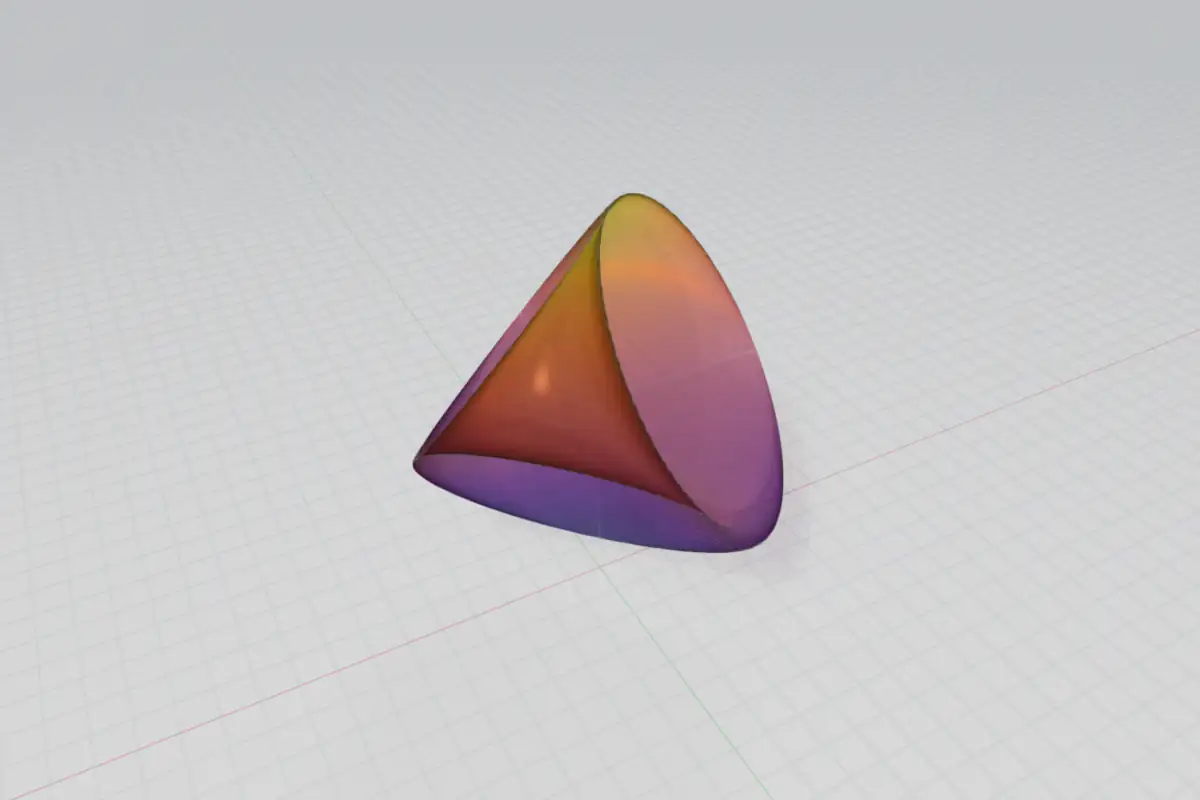
Jakob Steiner's quartic model of the projective plane — four lobes with tetrahedral symmetry meeting at a triple point.
The Roman surface, found by Jakob Steiner in 1844 during a stay in Rome — from which it takes its name — is a quartic surface that maps the real projective plane into three-dimensional space. It is the image of the unit sphere under the quadratic map (x, y, z) \to (yz, zx, xy) ; because every coordinate is a product of two, antipodal points of the sphere land on the same image, so the map descends to the projective plane. Unlike Boy's surface, the Roman surface is not a smooth immersion: it has three segments of self-intersection meeting at a triple point at the origin and terminating in six pinch points, and it carries the full tetrahedral symmetry of those points.
The parametrization uses standard spherical coordinates, x = \frac{1}{2}\sin u\sin(2v) , y = \frac{1}{2}\cos u\sin(2v) , z = \frac{1}{2}\sin(2u)\sin^2 v , with u \in [0, 2\pi] and v \in [0, \pi] . The glass material lets the three internal double-line creases and the central triple point show through the rounded tetrahedral shell, where an opaque surface would hide them. Steiner himself never published the surface; it was described in print by Karl Weierstrass in 1863.
JavaScript is required to view the interactive plot.