
Boy's Surface
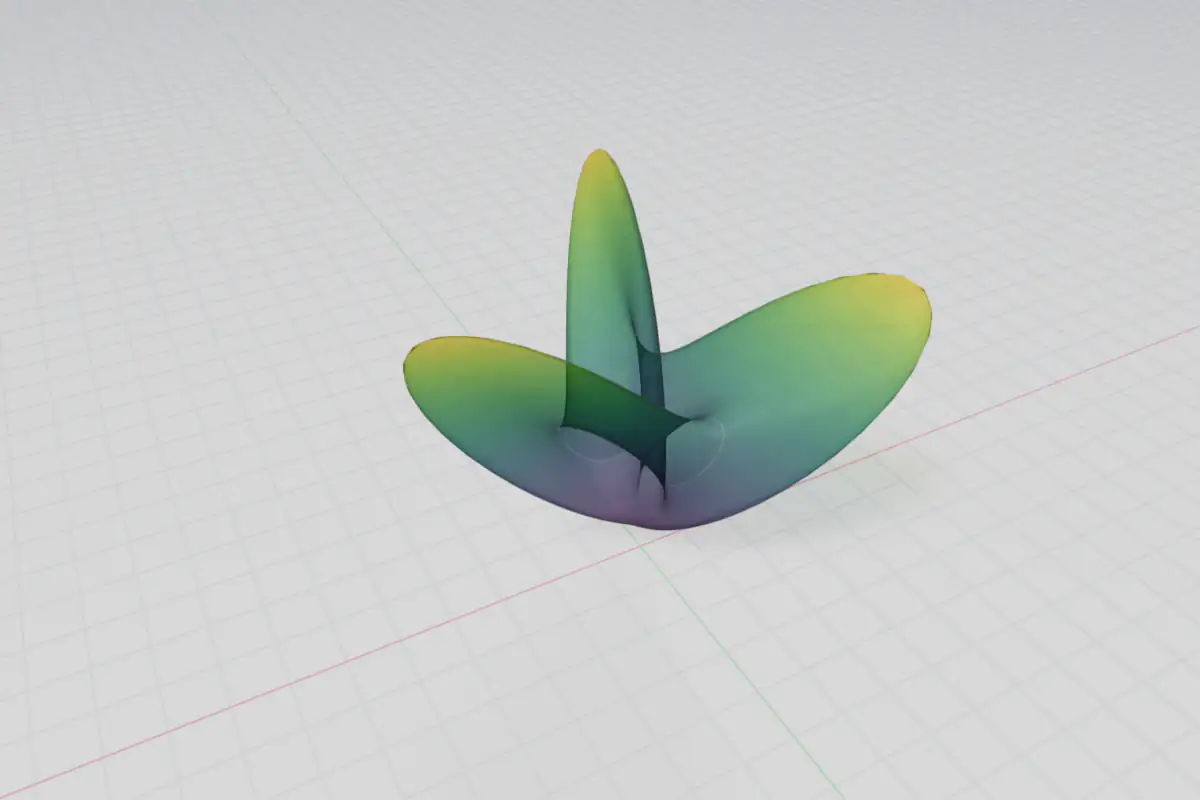
An immersion of the projective plane — a one-sided surface with three-fold symmetry and a single triple point.
Boy's surface is an immersion of the real projective plane in three-dimensional space — a closed, non-orientable surface with no edges and no singular points. It was discovered in 1901 by Werner Boy, a student of David Hilbert, who had asked Boy to prove that no such immersion could exist; Boy found one instead. Unlike the projective plane's algebraic cousin, the Roman surface, Boy's surface has no pinch points: it crosses through itself along a smooth curve of double points that meet at a single triple point, giving the surface its characteristic three-lobed, three-fold symmetric shape.
The rendering uses the Apéry parametrization, x = (\sqrt{2}\cos(2u)\cos^2 v + \cos u\sin(2v))/D , y = (\sqrt{2}\sin(2u)\cos^2 v - \sin u\sin(2v))/D , z = 3\cos^2 v/D , sharing the denominator D = 2 - \sqrt{2}\sin(3u)\sin(2v) , with u \in [-\pi/2, \pi/2] and v \in [0, \pi] . Because D never vanishes, the formula is smooth and bounded everywhere. The three petals fold over one another and merge at the central triple point — the visual signature that distinguishes Boy's surface from every other model of the projective plane.
JavaScript is required to view the interactive plot.