Cross-Cap
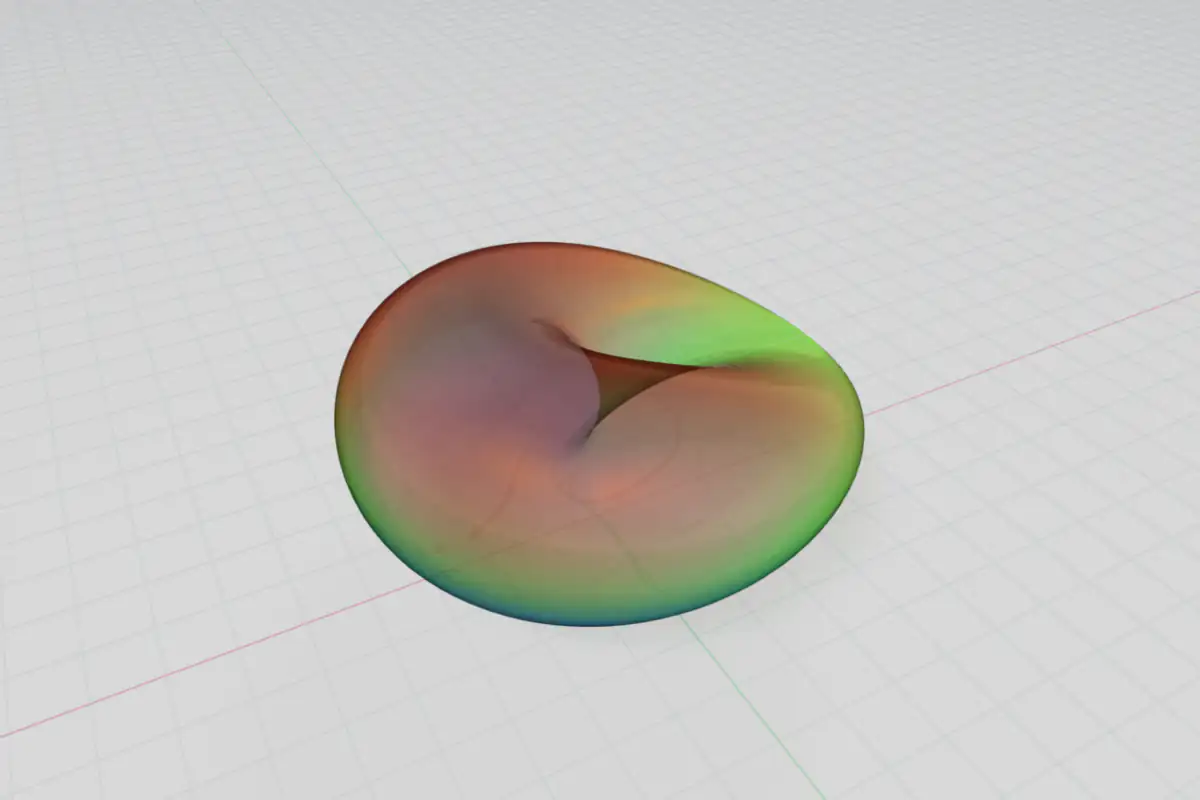
The simplest self-intersecting model of the projective plane — a pinched cap with one double-point segment and two pinch points.
The cross-cap is the simplest of the classical models of the real projective plane in three dimensions. In surface topology, attaching a cross-cap to a surface means forming its connected sum with a projective plane — capping a hole with a Möbius band rather than a disk. Realized as a closed surface in space it must intersect itself: it has a single segment of double points ending in two pinch points, about the simplest self-intersection structure possible. Like the Roman surface, and unlike Boy's surface, it is therefore not a smooth immersion.
This rendering uses the parametrization x = (1 + \cos v)\cos u , y = (1 + \cos v)\sin u , z = -\tanh(\frac{2}{3}(u - \pi))\sin v over u, v \in [0, 2\pi] , which closes the cross-cap into a surface equivalent to the projective plane. The \tanh factor produces the fold where the surface passes through itself; the glass material reveals that internal self-intersection crease and the two pinch points at its ends.
JavaScript is required to view the interactive plot.