Plasma Effect
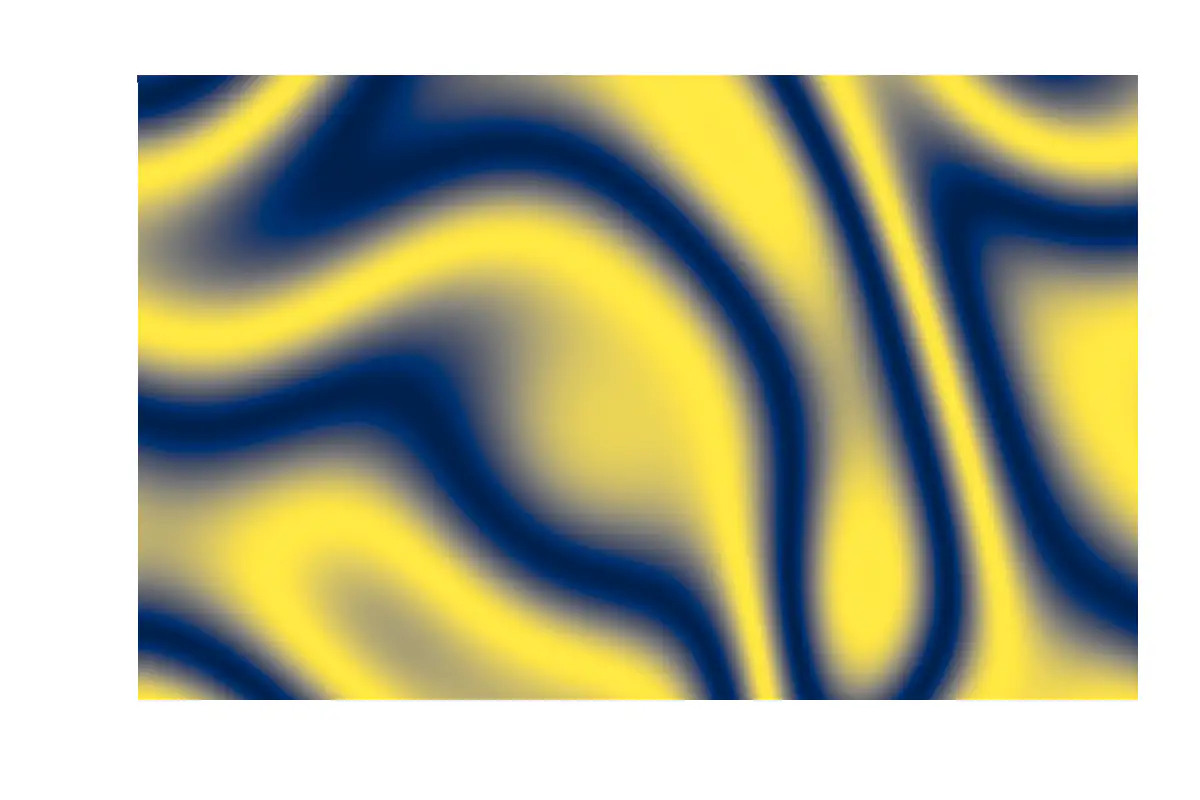
A drifting plasma pattern: two waves multiplied into one scalar field, shaded by a cosine ramp, with time animating.
A plasma effect is a classic of demoscene graphics: a few sines and cosines of the pixel position, mixed together and pushed through a color ramp, produce a slowly flowing pattern that never repeats exactly. This one is a port of a Shadertoy fragment shader (4tdGWX). Each point of the plane is first shifted by the time T , so the whole picture drifts diagonally. From the shifted point the document builds two phases, k from the vertical coordinate and w from the horizontal one, both of which also advance with T at their own rates, and the distance d to the origin. The field s = 7\cos(d + w)\sin(k + w) multiplies a radial wave by a wave in k , so the rings around the origin are modulated by horizontal bands.
The shader colors each pixel with the cosine palette 0.5 + 0.5\cos(s + (0.2, 0.5, 0.9)) , one channel per number. The three channels are nearly in phase, so the palette reads as a brightness ramp from a deep blue-black to a warm cream. The heatmap keeps that ramp: it plots 0.5 + 0.5\cos(s + 0.5) on [0, 1] through a dark-to-light palette. Because s spans about two full periods of the cosine, each ring appears twice as a bright and a dark band. The time T animates at one unit per second, as in the original.
JavaScript is required to view the interactive plot.