
Lagrange Points
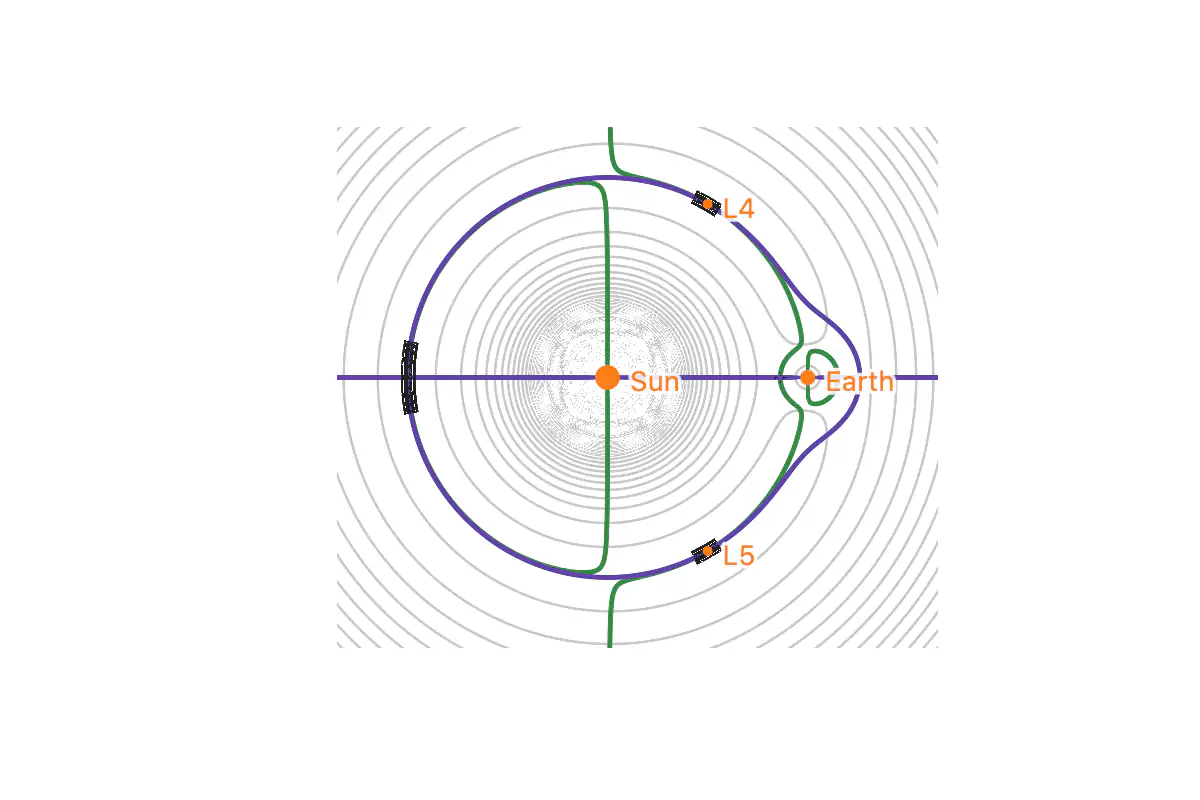
The five points where a satellite can hold still relative to the Sun and Earth — found where two force-component curves cross — with the Earth mass animating.
The Lagrange points are the five places in a two-body system where a small third body, such as a satellite, can sit still relative to both. In a frame that rotates with the Earth around the Sun, a satellite at rest feels the Sun's gravity, the Earth's gravity, and a centrifugal push away from the barycenter. Where those three cancel, the net force is zero and the satellite stays put: L1, L2 and L3 lie on the Sun–Earth line, while L4 and L5 sit at the corners of two equilateral triangles built on that line. The James Webb Space Telescope orbits L2; the Trojan asteroids gather at Jupiter's L4 and L5.
The document builds the force from named pieces — the distances r_s and r_e to each body, the barycenter b , the orbital rate \omega from Kepler's third law — and then writes its two components F_x(x, y) and F_y(x, y) . Two implicit curves draw where each component vanishes: the green curve is F_x = 0 and the violet curve is F_y = 0 , so a Lagrange point is exactly a crossing of green and violet. The dark blobs shade the region where |F|^2 \le 0.02 , marking each equilibrium and how tightly the force closes in around it, and the grey rings are contours of the effective potential \Omega (the force is its negative gradient). The Earth mass m_e animates from 0.3 to 3 against a Sun of mass 100 : L1 and L2 spread apart from the Earth as it grows heavier, L3 barely moves, and L4 and L5 stay fixed on the triangle for every mass ratio.
After a Desmos graph by Fabrice Neyret.
JavaScript is required to view the interactive plot.